

SpaceX’s $75 Billion IPO, in Five Charts
Where does $75 billion go?
SpaceX set terms on June 3: 555,555,555 shares of Class A common stock at an expected $135.00 per share. That is a base offering of roughly $75 billion, up to about $86 billion if the underwriters exercise their over-allotment in full. By capital raised, the base deal alone would be nearly three times the previous record, Saudi Aramco’s $25.6 billion in 2019.
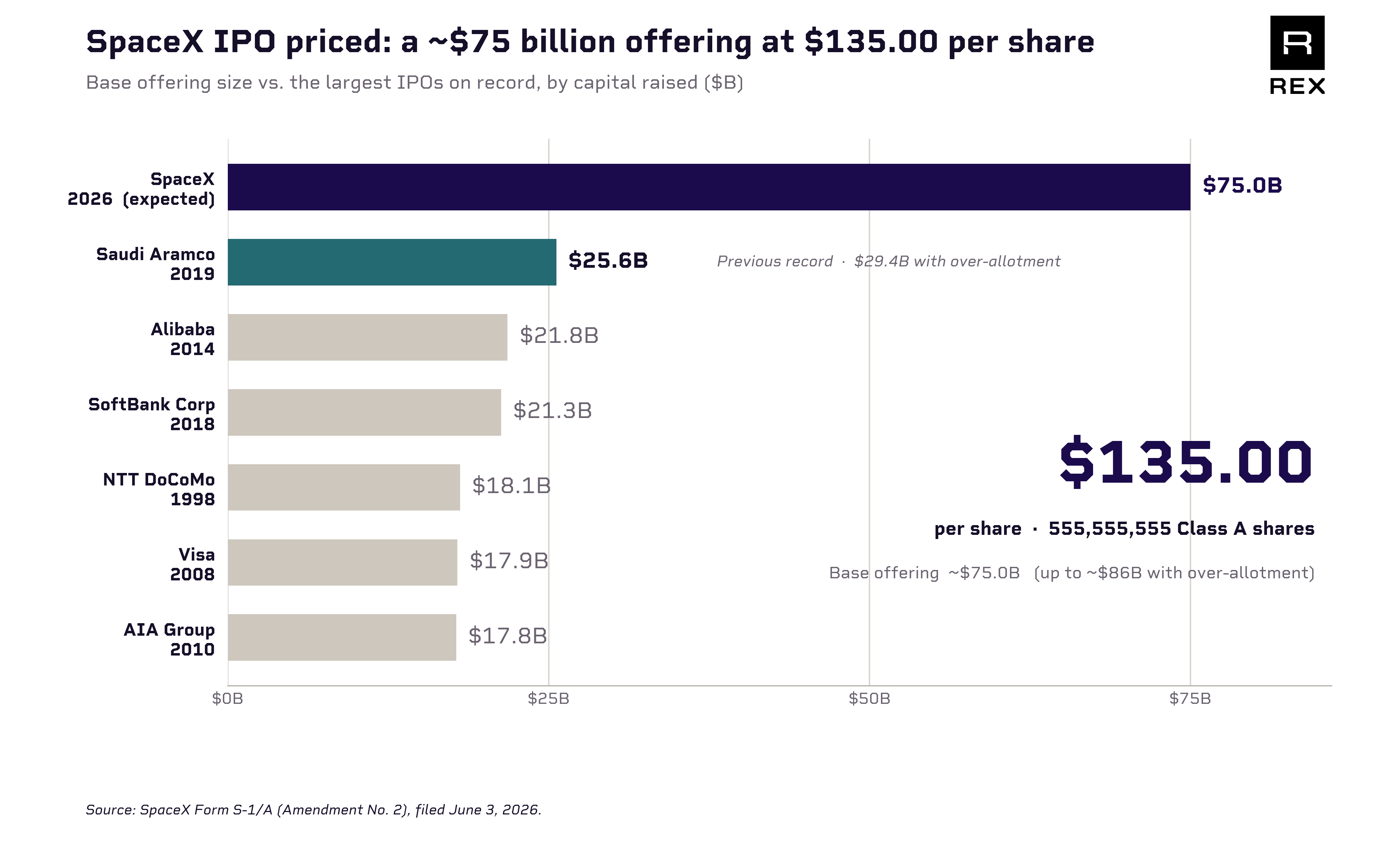
Most of the conversation since the filing has been about the valuation. The S-1 spends more pages answering a different question: what does SpaceX plan to do with the money? The filing’s segment data answers it, one chart at a time.
The revenue is a satellite story
Start with what SpaceX earns. Revenue grew from $10.4 billion in 2023 to $18.7 billion in 2025, up 80% in two years. One segment drove 91% of that growth: Connectivity, the Starlink business.
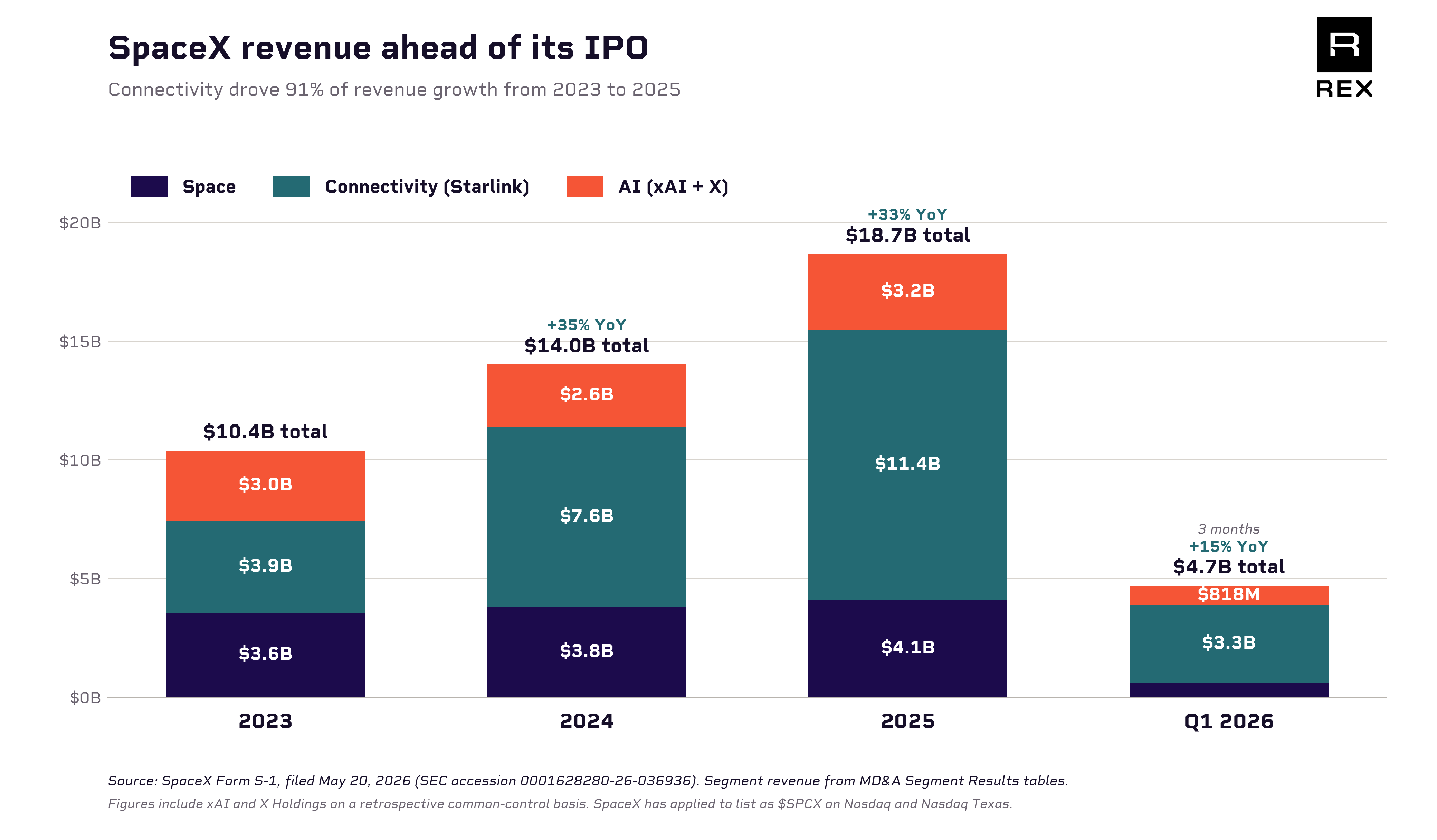
Starlink subscribers nearly quadrupled over those two years, reaching 10.3 million by the end of Q1 2026, even as monthly revenue per subscriber fell from $99 in 2023 to $66 in the latest quarter on a more international, lower-priced mix. Connectivity now produces 69% of total revenue, up from 37% in 2023.
The launch business (Falcon, Dragon, Starship) held nearly flat at $4.1 billion of revenue and ran a $657 million operating loss in 2025, a year in which it absorbed about $3.0 billion of Starship R&D.
One more thing about the entity on offer. This financial history was assembled in February 2026, when SpaceX acquired xAI, which had itself absorbed X in March 2025. All three were under common control, so the filing restates 2023 through 2025 as if they had always been one company. Buyers are getting a satellite internet provider, a launch business near breakeven, and an AI lab, combined four months before the listing.
The spending is an AI story
Revenue says satellite company. Capital expenditure says something different.
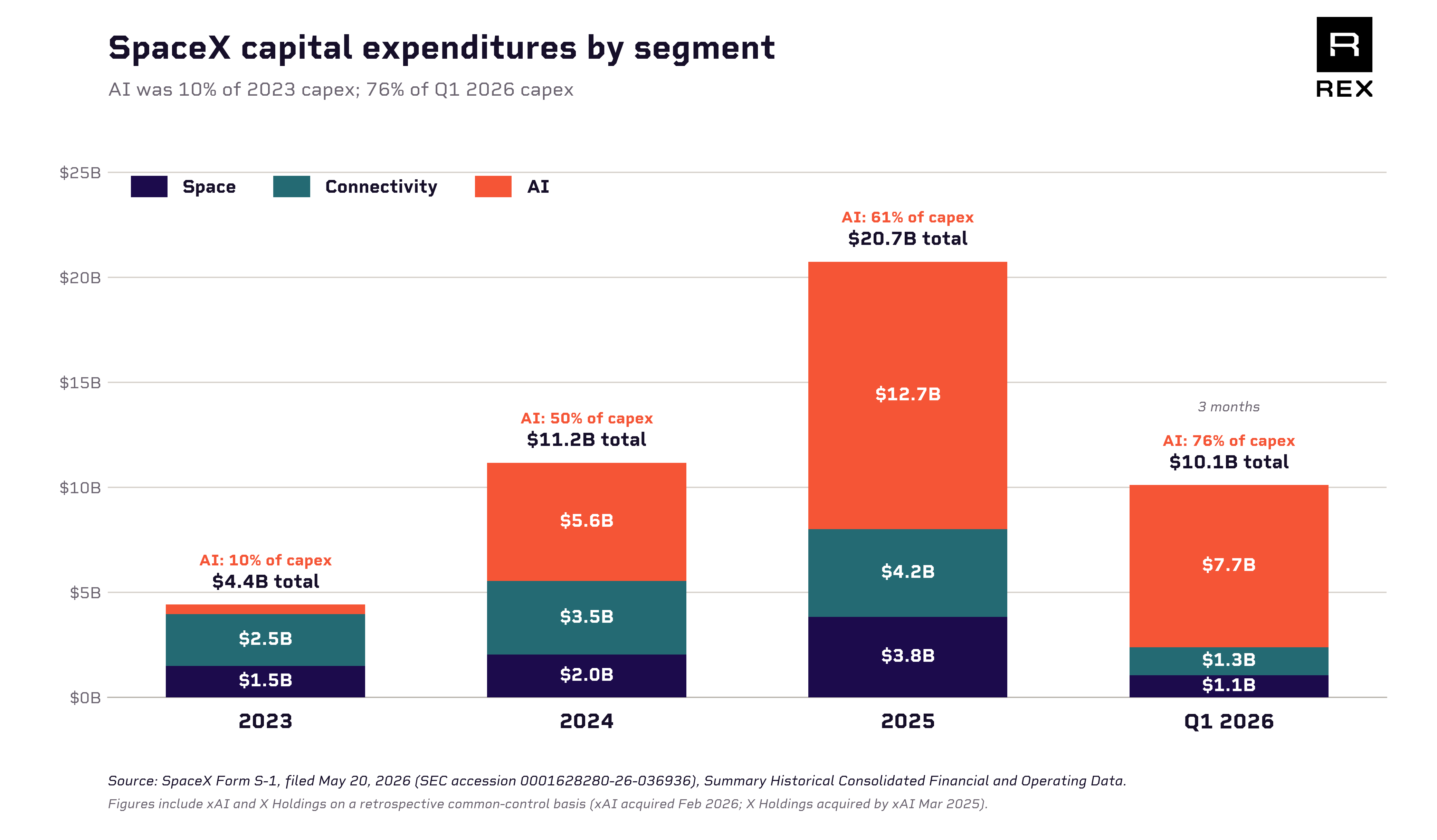
Total capex went from $4.4 billion in 2023 to $20.7 billion in 2025, then $10.1 billion in the first quarter of 2026 alone. The AI segment’s share of that spending went from 10% to 76%.
Three more numbers put the pace in context:
- 2025 capex ran about 3x operating cash flow ($20.7 billion against $6.8 billion)
- Cash and equivalents fell from $24.7 billion to $15.9 billion in a single quarter
- In March 2026, SpaceX borrowed $20 billion under a bridge loan that matures in September 2027
The S-1’s use-of-proceeds list opens with “expansion of AI compute infrastructure,” ahead of launch vehicles and satellite capacity. The filing says the bridge loan may be refinanced with notes or bank borrowings. However the financing resolves, the spending priority is stated in the filing’s own first line: AI compute.
One customer, $1.25 billion a month
The AI segment booked $3.2 billion of revenue in 2025 against a $6.4 billion operating loss. Then in May, one contract changed the segment’s arithmetic.
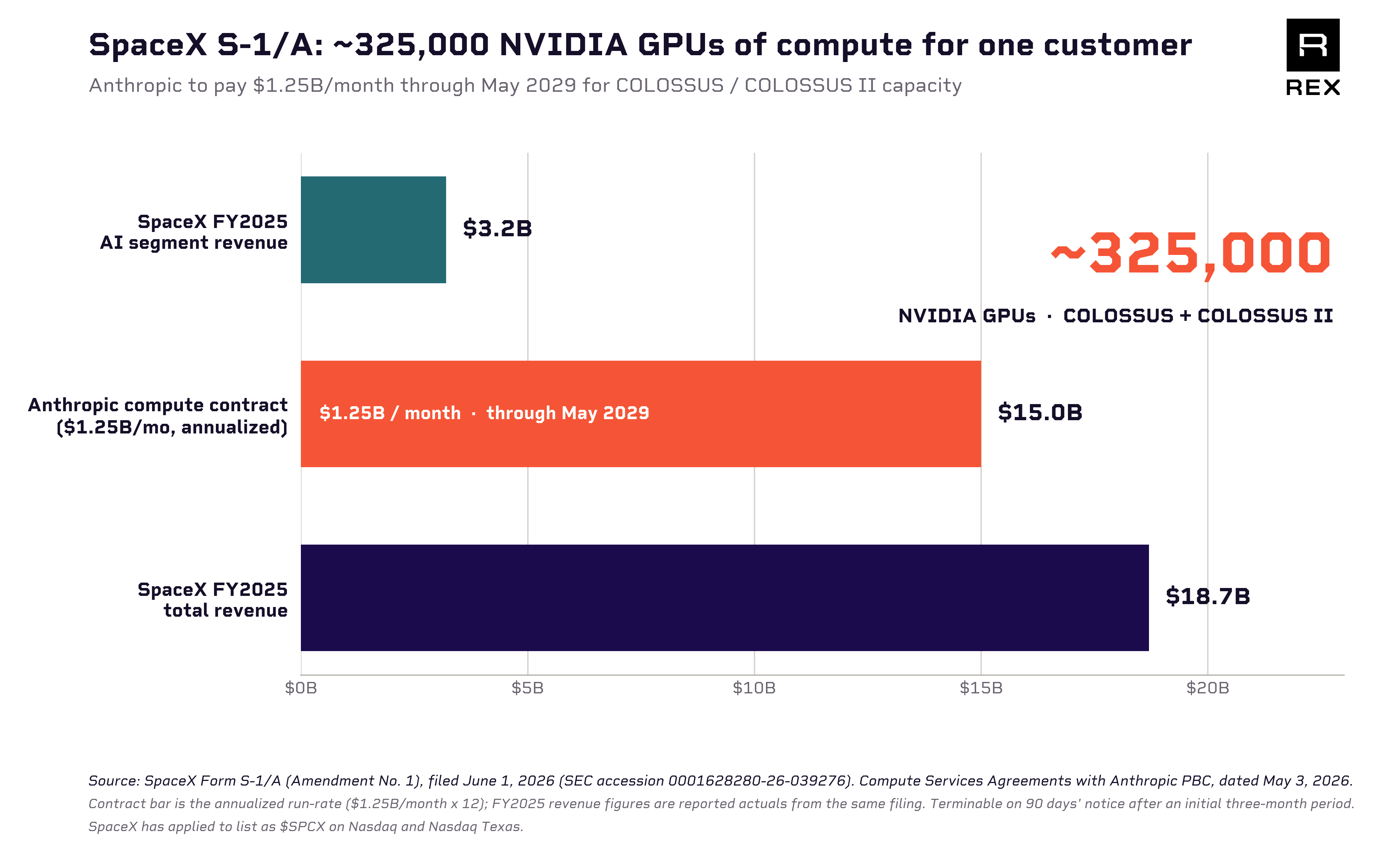
Anthropic agreed to pay SpaceX $1.25 billion per month through May 2029 for capacity on roughly 325,000 NVIDIA GPUs across the COLOSSUS and COLOSSUS II data centers. Annualized, that is $15 billion, nearly five times the AI segment’s entire 2025 revenue and not far from SpaceX’s total 2025 revenue of $18.7 billion. Anthropic’s own IPO is covered on a separate page.
One term belongs next to the $45 billion headline total: either party can terminate on 90 days’ notice after an initial three-month period. The contracted number is enormous. The committed number is one quarter at a time.
The other AI revenue line
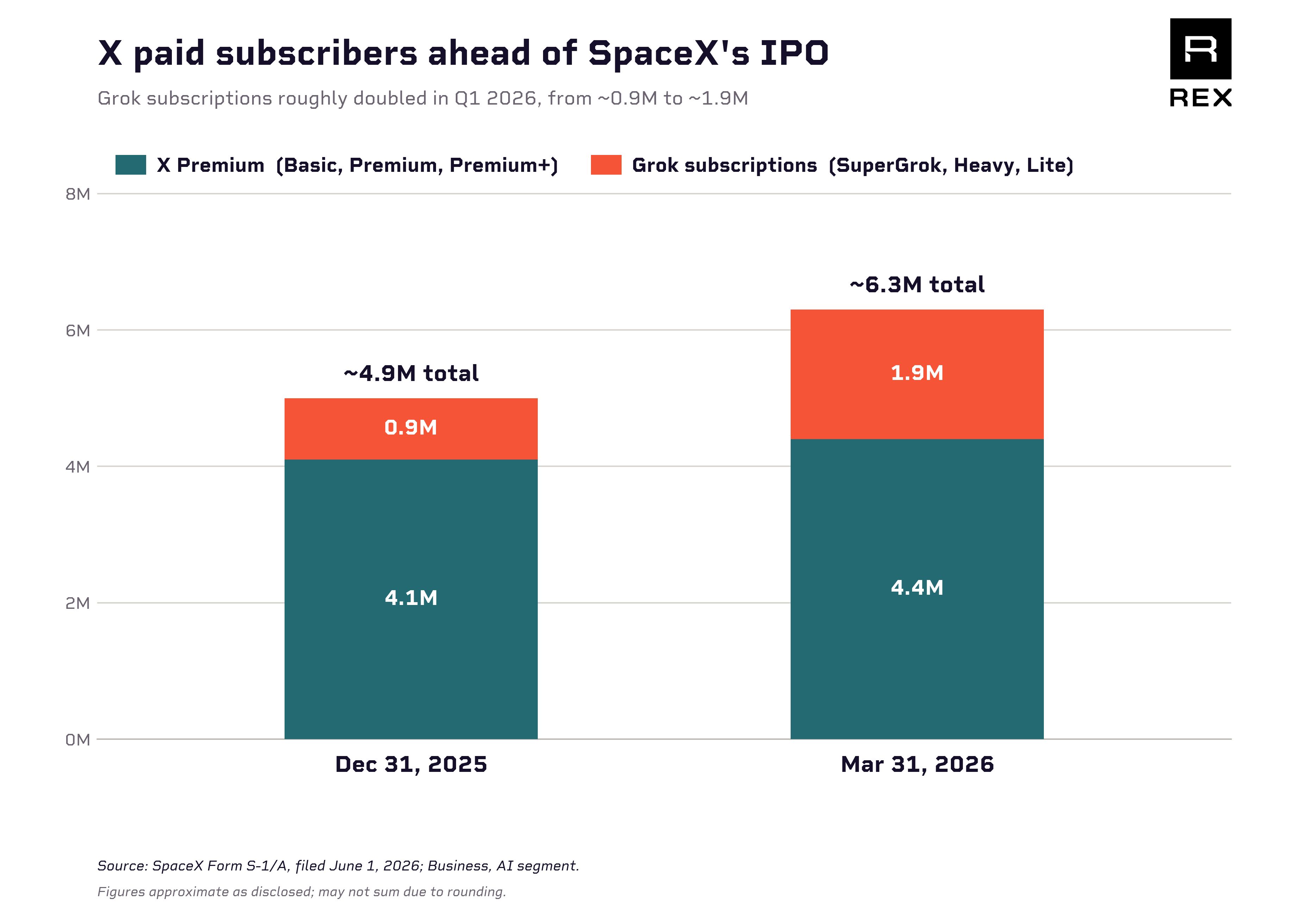
Paid subscriptions across X and Grok rose from about 4.9 million on December 31 to about 6.3 million on March 31, up 29% in a quarter. Grok subscriptions roughly doubled, from about 0.9 million to 1.9 million. Beneath the paid layer, the filing counts approximately 550 million monthly active users across X and Grok as of March 31, 2026, with about 117 million of them using Grok’s AI features, up from 89 million a quarter earlier.
Read the ambition, then watch the dates
The filing states its own scale plainly. SpaceX estimates a $28.5 trillion addressable market, which it calls “the largest actionable total addressable market in human history.” $26.5 trillion of that estimate sits in AI. The risk factors concede those market estimates may prove wrong.
The compensation plan says the same thing in different units. Elon Musk’s base salary is $54,080 and has not changed since 2019. His new performance award, about 1.3 billion restricted shares, vests on milestones that include market-cap targets running up to $7.5 trillion, a one-million-person Mars colony, and 100 terawatts of data-center capacity off Earth. Post-IPO, Musk holds about 82.4% of the voting power.
At the expected price, the post-offering share count implies an equity value near $1.77 trillion (our arithmetic from the filing’s share counts; excludes the over-allotment).
Three dates to watch from here:
- Final pricing. $135.00 is the stated expectation; the actual price arrives with the final prospectus.
- The first trade, on Nasdaq and Nasdaq Texas under the ticker SPCX.
- Starship’s first payload to orbit, expected in the second half of 2026. The next generation of Starlink, Starlink Mobile at scale, and the planned orbital AI data centers all depend on that vehicle flying.
Starlink built the revenue. The raise funds the AI build. That is where $75 billion goes.
Sources: SpaceX Form S-1 (filed May 20, 2026), Form S-1/A Amendment No. 1 (filed June 1, 2026), and Form S-1/A Amendment No. 2 (filed June 3, 2026), via SEC EDGAR. Figures as disclosed in the filings; the expected offering price is subject to change until final pricing. REX Shares is not affiliated with SpaceX. This article is for informational purposes only and is not investment advice or an offer or solicitation to buy or sell any security.
