

DACLREX Defensive Autocallable Income ETF
Distribution Rate*: 6.63%
As of 09/14/2026
30-Day SEC Yield**: 3.21%
As of 09/30/2026
The Distribution Rate represents a single distribution from the ETF and does not represent its total return. A portion of distributions may consist of return of capital (ROC). For full details on the composition of distributions, please refer to the latest 19a-1 notice. The distribution may include a combination of ordinary dividends, capital gain, and return of investor capital, which may decrease a fund’s NAV and trading price over time. As a result, an investor may suffer significant losses to their investment. These distribution rates caused by unusually favorable market conditions may not be sustainable. Such conditions may not continue to exist and there should be no expectation that this performance may be repeated in the future. Additional fund risks can be found below.
Why DACL
The Strategy
DACL Strategy:
The REX Defensive Autocallable Income ETF seeks to deliver income of 3% above SOFR while enhancing diversification through exposure to a daily laddered portfolio of synthetic autocallables within an ETF structure, compared with traditional weekly laddered approaches. Each underlying autocallable exposure incorporates a 50% Risk Buffer at maturity. If its reference index finishes below the Risk Buffer at maturity, losses accrue at 200% of the decline beyond the buffer. This downside mitigation is determined only at each autocallable exposure’s final maturity.
-40%
Coupon Mitigation
Monthly coupon barriers are set at 60% of the initial strike, providing 40% downside mitigation for income generation. Each monthly observation is independent.
-50%
Risk Buffer Protection
A 50% Risk Buffer with a 200% Gearing Factor on declines beyond the buffer. Principal is returned at maturity unless the index finishes below the 50% Risk Buffer; below it, principal is reduced by 200% of the shortfall. Observed only at maturity if the position has not been previously autocalled.
5 YEAR
Predefined Maturity
Each autocallable has a 5-year term with monthly autocall observation after the 1st year. If the index is at or above its initial strike, the position is automatically called.
Daily Laddered Portfolio Maintenance:
New autocallable positions are added daily, regardless of whether existing positions are autocalled or mature. The index maintains a minimum of 252 and a maximum of 1,262 autocallable positions, supporting continuous diversification over time.
Monthly Coupon Distribution:
DACL distributes coupon income to shareholders on a monthly basis, targeting an annualized yield of 3% + SOFR, offering investors a consistent income stream that adjusts with short-term interest rates.
Index Parameters:
Reference Index:
Bloomberg US Large Cap VolMax 30 Index
Bloomberg US Large Cap VolMax 30 Index
Reference Index Vol Target:
30%
30%
Reference Index Decrement:
4% per annum
4% per annum
Coupon Barrier:
60%
60%
Downside Protection:
Risk Buffer (buffered)
Risk Buffer (buffered)
Risk Buffer / Gearing Factor:
50% / 200%
50% / 200%
Coupon Rate:
SOFR + 3%
Per autocallable position terms. Autocall Barrier Observation: Monthly, beginning after 1 year. Coupon Observation: Monthly. Risk Buffer Observation: Final Maturity. Downside: Risk Buffer 50%, Gearing Factor 200%. Tenor: 5 years. Reference Index Decrement: 4% per annum.
Investment in DACL is subject to risks associated with the autocallable structure, as well as broader market risk. Investors should be prepared to bear loss of principal. There can be no assurance that the Fund will achieve its investment objective, and coupon payments are not guaranteed. Diversification does not assure a profit or protect against loss in a declining market.
Each Autocallable Contract also incorporates a protection payoff feature so that negative performance relative to the level of the Underlying Reference Index at the Autocallable Contract’s Strike Date will not produce a negative settlement outcome at maturity, provided the Underlying Reference Index is not below a certain predetermined level at maturity (the “Risk Buffer”). However, if the value of the Underlying Reference Index declines more than the Risk Buffer at the Autocallable Contract’s maturity, the settlement value of the Autocallable Contract will be reduced equal to the negative performance of the Underlying Reference Index (measured from its initial value to its final value on the maturity date) beyond the Risk Buffer multiplied by a “Gearing Factor”. The Gearing Factor is a multiplier applied to losses in excess of the Risk Buffer at maturity and is designed to implement a linear reduction in settlement value once the Risk Buffer is breached, capped at a full loss of the settlement value (i.e. where the Underlying Reference Index value at maturity relative to the strike date has fallen 100%). For example, if the value of the Underlying Reference Index is 49% of the strike date level, the settlement value will be 98% (51% Underlying Reference Index performance – 50% Risk Buffer = 1% * 200% Gearing Factor = 2% reduction of settlement value). Therefore, if the Underlying Reference Index is at or above the Risk Buffer at the Autocallable Contract’s maturity, the settlement value will not be reduced below the initial notional amount. If the Underlying Reference Index is below the Risk Buffer at the Autocallable Contract’s maturity, the settlement value will be reduced only by the amount of the decline below the Risk Buffer, multiplied by the Gearing Factor. While the application of the Gearing Factor results in a loss that is greater than the percentage decline of the Underlying Reference below the Risk Buffer, the settlement value loss of an individual Autocallable Contract cannot exceed the actual decline of the Underlying Reference Index. The application of the Gearing Factor could, in extreme scenarios, reduce the settlement value of an individual Autocallable Contract to zero, although it cannot be less than zero.
Key DACL Details:
The Total Annual Fund Operating Expenses is 0.74%. REX Advisers, LLC, the Fund’s investment adviser, has contractually agreed to waive a portion of the management fee equal to 0.09% of average daily net assets of the Fund at least through July 31, 2027. The agreement may be terminated by the Trust, on behalf of the Fund, for any reason and at any time and by the Fund’s investment adviser only after July 31, 2027 upon 30 days’ prior notice to the Trust.
Median 30 Day Spread is a calculation of Fund’s median bid-ask spread, expressed as a percentage rounded to the nearest hundredth, computed by: identifying the Fund’s national best bid and national best offer as of the end of each 10 second interval during each trading day of the last 30 calendar days; dividing the difference between each such bid and offer by the midpoint of the national best bid and national best offer; and identifying the median of those values.
DACL Distribution:
*The Distribution Rate is the annual yield an investor would receive if the most recently declared distribution, which includes option income, remained the same going forward. The Distribution Rate is calculated by multiplying an ETF’s Distribution per Share by twelve (12), and dividing the resulting amount by the ETF’s most recent NAV. The Distribution Rate represents a single distribution from the ETF and does not represent its total return. A portion of distributions may consist of return of capital (ROC). For full details on the composition of distributions, please refer to the latest 19a-1 notice. **The 30-Day SEC Yield represents net investment income, which excludes option income, earned by such ETF over the 30-Day period, expressed as an annual percentage rate based on such ETF’s share price at the end of the 30-Day period. Distributions are not guaranteed.
The Distribution Rate and 30-Day SEC Yield is not indicative of future distributions, if any, on the ETFs. In particular, future distributions on any ETF may differ significantly from its Distribution Rate or 30-Day SEC Yield. You are not guaranteed a distribution under the ETFs. Distributions for the ETFs (if any) are variable and may vary significantly from month to month and may be zero. Accordingly, the Distribution Rate and 30-Day SEC Yield will change over time, and such change may be significant. The distribution may include a combination of ordinary dividends, capital gain, and return of investor capital, which may decrease a fund’s NAV and trading price over time. As a result, an investor may suffer significant losses to their investment. These distribution rates caused by unusually favorable market conditions may not be sustainable. Such conditions may not continue to exist and there should be no expectation that this performance may be repeated in the future. Additional fund risks can be found below.
DACL Dashboard:
FAQ
An autocallable is an equity-linked note whose income and principal depend on how a reference asset (reference index) performs versus pre-set barriers over time. It pays coupons as long as the index stays above an income (coupon) barrier, as measured on monthly observation dates, and it returns principal at maturity (or earlier if called) if the index stays above a risk (maturity) barrier. If the index breaches that risk barrier at maturity, investors can lose principal based on the index decline below the Risk Buffer, as amplified by the Gearing Factor, receiving only limited downside protection and forgoing potential principal appreciation in exchange for the opportunity to earn higher, conditional income.
These scenarios only apply at the scheduled observation dates, when the note is evaluated against its barriers. At each observation date, the issuer checks the index level to determine whether the note autocalls, continues, or remains exposed to potential principal loss at maturity. If the index is at or above the call barrier on an observation date, the note typically autocalls, income is paid, and principal is returned. If the index is below the call barrier but above the risk barrier, the note generally stays outstanding and income may continue, subject to future observations. If, at maturity, the index finishes below the Risk Buffer, investors can lose principal based on the decline beyond the Risk Buffer as amplified by the Gearing Factor, reflecting the tradeoff between conditional income and equity downside risk.
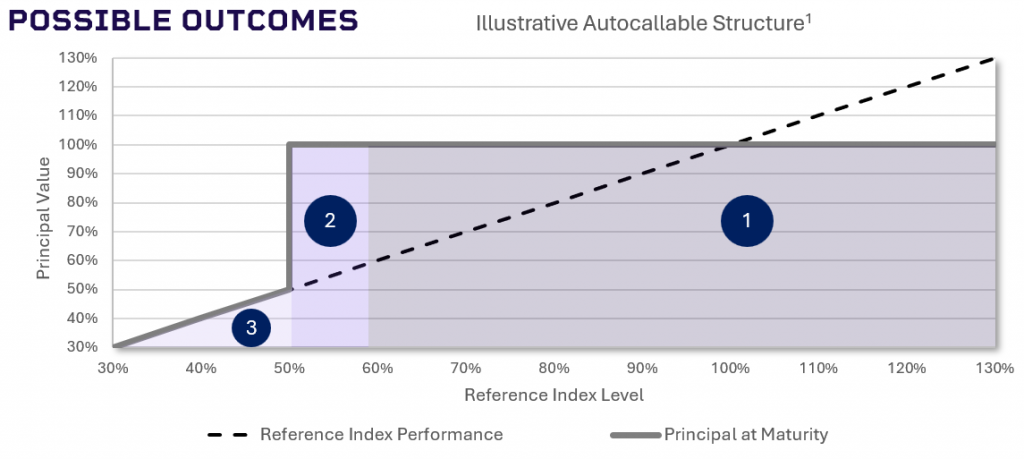
Scenario 1: Index rises, remains flat, or declines less than 40%
Result: Income paid + principal returned at maturity or upon call
Scenario 2: Index declines between 40% and 50%
Result: Income paused below the 60% coupon barrier; principal returned at maturity
Scenario 3: Index declines more than 50%
Result: Income paused below the 60% coupon barrier; below the 50% Risk Buffer, principal reduced by 200% of the decline beyond the buffer (200% Gearing Factor)
For illustrative purposes only.
1| Assumes a representative autocallable with a 60% coupon barrier, a 50% Risk Buffer, a 200% Gearing Factor, and monthly observation periods.
2|After 1-year non-call period, autocallables will return principal if reference index positively breaches 100% at any observation date.
TIMING DIVERSIFICATION
Daily laddering across 252-1262 autocallables spreads entry and observation dates, helping reduce reliance on any single strike or maturity.
AUTOMATIC REINVESTMENT
Proceeds from calls and maturities are redeployed automatically, keeping capital invested without sourcing new deals or managing calendars.
INSTANT DIVERSIFICATION
One ticker delivers exposure to a portfolio of autocallables, replacing the work of building and monitoring a multi-note basket.
EXCHANGE LIQUIDITY
Investors get live pricing and intraday trading on exchange, instead of negotiating opaque dealer quotes for individual notes.
TAX SIMPLICITY
A single fund position with consolidated 1099 reporting avoids tracking coupons, calls, and redemptions across multiple notes and dealers
Daily laddering across 252-1262 autocallables spreads entry and observation dates, helping reduce reliance on any single strike or maturity.
Proceeds from calls and maturities are redeployed automatically, keeping capital invested without sourcing new deals or managing calendars.
One ticker delivers exposure to a portfolio of autocallables, replacing the work of building and monitoring a multi-note basket.
Investors get live pricing and intraday trading on exchange, instead of negotiating opaque dealer quotes for individual notes.
A single fund position with consolidated 1099 reporting avoids tracking coupons, calls, and redemptions across multiple notes and dealers
DACL seeks monthly income by gaining exposure, via total return swaps, to a daily laddered portfolio of 252-1,262 synthetic autocallables tied to the Bloomberg US Large Cap VolMax Index. Each autocallable pays a coupon when the index is above its coupon barrier (around a 40% drawdown level), and the value of the total return swap held by the fund reflects these coupons. DACL aggregates this swap income and makes distributions to shareholders on a monthly basis, targeting a spread of approximately 3% above the floating SOFR rate, though actual distributions are not guaranteed and may vary or be zero in some months.
The Bloomberg US Large Cap VolMax Index is a volatility targeted equity index that dynamically adjusts exposure to the Bloomberg US Large Cap Total Return Index to target a 30% volatility level. This index serves as the reference index for the underlying autocallables, meaning barrier tests are based on its level rather than on individual stocks.
Key risks include geared downside risk (if the index finishes below the 50% Risk Buffer at maturity, principal for that autocallable is reduced by 200% of the decline beyond the buffer), contingent income risk (coupons are not guaranteed and may stop if the index falls below coupon barriers), and early redemption risk (autocalls can be called away in rising markets, which could lead to reinvestment at lower yields). DACL also faces derivatives and counterparty risk from its swap exposure, market and volatility target index risk, liquidity risk, non-diversification and concentration risk, NAV erosion and distribution risk (distributions can significantly reduce NAV over time and may include return of capital), cyber security risk, and new fund risk given its limited operating history.
If the reference index breaches the coupon barrier (a 40% decline) on an observation date, coupons for that period are not paid on the affected autocallables, though others in the ladder may still pay if their barriers are not breached. If at final maturity the reference index is below the 50% Risk Buffer, principal on that autocallable is reduced by 200% of the decline beyond the buffer (for example, a 60% index decline, finishing at 40% of the initial level, is 10% beyond the strike and results in a 20% loss on that position), up to a total loss of that position’s principal, which can lead to significant NAV losses for the fund.
Autocallables Reinvented:
Traditional autocallables require manual intervention, periodic monitoring, and expose investors to single-day entry-point risk. An index-based solution transforms autocallable payoff mechanics into a transparent, repeatable, and rules-based framework enabling systematic access, comparability, and ongoing monitoring over time.
Traditional Autocallables
Single Issuance Date
Concentrated entry-point risk tied to one market level
Manual Reinvestment
Proceeds must be redeployed when positions are called or mature
Opaque Pricing
Individual bank counterparties with negotiated dealer quotes
DACL Index-Based Solution
Laddered Entry Points
Daily diversification across multiple market levels over time
Automated Reinvestment
Coupons and proceeds reinvested systematically back into the index
Transparent Index
Bloomberg-calculated, daily, rules-based methodology
Yield generated from the portfolio of autocallables is automatically reinvested back into the index, supporting continuous compounding without manual intervention.
Key Index Features:
Systematic Laddering
Daily laddering distributes exposure across multiple autocallable entry points across time
Single Reference Index
All contracts reference a single volatility-managed equity index (Bloomberg VolMax)
Rules-based Construction
Defined methodology governing contract creation, valuation, and lifecycle events
Stable & Consistent Yield
Laddered exposure designed for a steadier income profile by spreading coupons across time
Standardized Autocallable Terms
Consistent contract parameters applied across all constituents
Transparent Pricing & Calculation
Index level calculated daily with systematic contract valuation.
| Bloomberg Ticker | BMAXDACL |
| Launch Date | 8/12/2026 |
| Index Base Date | October 31, 2006 |
| Calculation / Rebalancing | Daily |
| Coupon Rate | SOFR + 3% |
| Autocall / Coupon / Put Strike | 100% / 60% / 50% |
| Maturity / Non-Call | 5 years / 1 year |
| Risk Buffer / Gearing Factor | 50% / 200% |
| Reference Index Decrement | 4% per annum |
| Currency | USD |
Funding Rate: Applied to the reference index, SOFR + 50bps p.a. Annual Deduction Factor: 4% per annum. Source: Bloomberg, Feb 2026.
Downside at Maturity: Risk Buffer vs. Barrier
Both DACL and ATCL observe downside only at final maturity, and only if a position has not previously autocalled. They differ in how a decline is translated into principal loss.
DACL: 50% Risk Buffer
Principal is returned in full unless the reference index finishes below the 50% Risk Buffer. Below the buffer, the settlement value is reduced by the decline beyond the buffer multiplied by the 200% Gearing Factor. Loss on an individual Autocallable Contract can never exceed the actual decline of the reference index, and cannot fall below zero.
ATCL: 50% Barrier
Principal is returned in full unless the reference index finishes below the 50% barrier. If the barrier is breached, loss is measured from the initial index level rather than from the barrier, so principal is reduced in line with the full index decline.
For illustrative purposes only. Downside is observed only at final maturity if a position has not previously autocalled. See each Fund’s prospectus for complete terms.
How It Is Built
Index Construction Framework:
The Bloomberg US Large Cap VolMax Defensive Autocallable Index represents a synthetic, laddered portfolio of autocallable derivatives maintained under predefined index rules and referencing a single volatility-managed equity index.
Step 1
Equity Index
Bloomberg 500 (B500)
Represents the 500 largest U.S. companies by market capitalization. Serves as the core U.S. equity exposure.
Step 2
Reference Index
VolMax (BMAXUS30)
A volatility-targeted index targeting 30% volatility using the B500. Dynamically leverages and deleverages exposure.
Step 3
Synthetic Derivatives
Autocallable Notes
Rules-based autocallable payoff representations referencing Bloomberg US Large Cap VolMax Index. 252 to 1,260 positions maintained.
Step 4
Autocallable Index
BMAXDACL
A diversified, laddered portfolio representing autocallable payoff characteristics within a rules-based index framework.
DACL Performance:
The performance data quoted represents past performance. Past performance does not guarantee future results. The investment return and principal value of an investment will fluctuate so that an investor’s shares, when sold or redeemed, may be worth more or less than their original cost and current performance may be lower or higher than the performance quoted. Performance current to the most recent month-end can be obtained by calling 1-844-802-4004. Short term performance, in particular, is not a good indication of the fund’s future performance, and an investment should not be made based solely on returns.
Market Price: The current price at which shares are bought and sold. Market returns are based upon the last trade price.
NAV: The dollar value of a single share, based on the value of the underlying assets of the fund minus its liabilities, divided by the number of shares outstanding. Calculated at the end of each business day.
DACL Holdings:
The Fund, under normal market conditions, maintains a diversified ladder of 252-1260 synthetic autocallables written daily on the Bloomberg US Large Cap VolMax Index via total return swaps linked to the US Bloomberg Large Cap VolMax Defensive Autocallable Index. Each autocallable has specific maturity dates, barrier levels, and coupon rates. The fund also holds treasuries.
Fund holdings are subject to change.
DACL Holdings:
The Fund, under normal market conditions, maintains a diversified ladder of 252-1260 synthetic autocallables written daily on the Bloomberg US Large Cap VolMax Index via total return swaps linked to the US Bloomberg Large Cap VolMax Defensive Autocallable Index. Each autocallable has specific maturity dates, barrier levels, and coupon rates. The fund also holds treasuries.
Fund holdings are subject to change.
Get in Touch
The REX Defensive Autocallable Income ETF is brought to you by REX Shares an innovative ETP provider that specializes in alternative-strategy ETFs and ETNs. The firm created the MicroSectors and co-created the T-REX product lines of leveraged and inverse tools for traders and recently launched a series of option-based income strategies. The firm is rooted in decades of experience building inventive solutions that solve for a range of specific challenges in investor and trader portfolios.
Schedule a time to talk to a team member or submit a form.
Important Information
“Bloomberg®” and the indices referenced herein (the “Indices”, and each such index, an “Index”) are trademarks or service marks of Bloomberg Finance L.P. and its affiliates, including Bloomberg Index Services Limited (“BISL”), the administrator of the Index (collectively, “Bloomberg”) and/or one or more third-party providers (each such provider, a “Third-Party Provider,”) and have been licensed for use for certain purposes to REX ADVISERS LLC (the “Licensee”). To the extent a Third-Party Provider contributes intellectual property in connection with the Index, such third- party products, company names and logos are trademarks or service marks, and remain the property, of such Third-Party Provider. Bloomberg is not affiliated with the Licensee or a Third-Party Provider, and Bloomberg does not approve, endorse, review, or recommend the financial products referenced herein (the “Financial Products”). Bloomberg does not guarantee the timeliness, accurateness, or completeness of any data or information relating to the Indices or the Financial Products.
The Fund enters into unfunded total return swap agreements with one or more major financial institutions to obtain exposure to the Bloomberg US Large Cap VolMax Defensive Autocallable Total Return Index.
Investing in the Fund involves a high degree of risk. As with any investment, there is a risk that you could lose all or a portion of your investment in the Fund.
An investor should carefully consider the Fund’s investment objective, risks, charges, and expenses before investing. The Fund’s prospectus and summary prospectus contain this and other information about REX Shares. To obtain the Fund’s prospectus and summary prospectus call 1-844-802-4004. The Fund’s prospectus and summary prospectus should be read carefully before investing.
THE FUND, TRUST, AND ADVISER ARE NOT AFFILIATED WITH THE BLOOMBERG US LARGE CAP VOLMAX DEFENSIVE AUTOCALLABLE TOTAL RETURN INDEX, THE BLOOMBERG US LARGE CAP VOLMAX INDEX, THE BLOOMBERG US LARGE CAP TOTAL RETURN INDEX, OR BLOOMBERG LP.
AUTOCALLABLE CONTRACTS RISK. Autocallable Contracts differ in various ways from traditional debt securities. Autocallable Contracts do not guarantee a return of principal or any coupon payments thereunder and limit the positive investment return that can be achieved due to the automatic call feature that is triggered when the Underlying Reference Index’s performance meets or exceeds the Autocallable Barrier on a predetermined Observation Date following a one-year Non-Callable Period.
HIGH PORTFOLIO TURNOVER RISK. The Fund may actively and frequently trade all or a significant portion of the Fund’s holdings. A high portfolio turnover rate increases transaction costs, which may increase the Fund’s expenses.
Autocallable Structure Risk. The Fund’s returns are linked to a structured autocallable index, which may limit upside participation and expose investors to complex payoff patterns that differ from direct investments in the underlying securities.
Barrier Risk. If the underlying reference index breaches specified barrier levels, principal and income protections may be reduced or lost, potentially resulting in significant losses of invested capital.
Geared Downside Risk. Below the 50% Risk Buffer, losses on each autocallable accrue at 200% of the index decline beyond the strike (a 200% gearing factor), which magnifies principal losses in severe declines, up to a total loss of a position’s principal.
Coupon/Contingent Income Risk. Coupon payments are contingent on barrier conditions being met and are not guaranteed; in unfavorable market environments, investors may receive little or no income.
Early Redemption Risk. Autocallable features can cause positions to be redeemed early in rising markets, forcing reinvestment at potentially lower yields and limiting participation in continued market gains.
Market Risk. The value of the Fund will fluctuate with overall market conditions and the performance of the underlying reference index, and investors could lose money, including principal.
Volatility Target Index Risk. The volatility-targeted reference index may underperform traditional equity indices because of its leverage caps, volatility adjustment mechanism, and embedded financing or cost overlays.
Active Management Risk. The Fund’s performance depends on the investment decisions and risk management techniques of the adviser, which may not achieve the intended results and could cause the Fund to underperform.
Liquidity Risk. Certain instruments, including derivatives referencing structured notes or indices, may become difficult or costly to trade, which can impact pricing, portfolio management, and the ability to meet redemptions.
Derivatives Risk. The Fund’s use of derivatives may magnify gains and losses, introduce leverage, and create exposure to valuation, correlation, and operational risks that can adversely affect performance.
Options Contracts Risk. Options can expire worthless, are sensitive to changes in volatility, time decay, and the price of the underlying asset, and may be less liquid than other securities.
Swap Agreements Risk. The Fund may utilize swap agreements to derive its exposure to shares of the underlying reference asset. Swap agreements may involve greater risks than direct investment in securities as they may be leveraged and are subject to credit risk, counterparty risk and valuation risk.
New Fund Risk. Because the Fund is newly formed, it has a limited operating history and there can be no assurance that it will be successful in implementing its investment strategy.
Underlying Reference Index and Volatility Targeting Risk. Performance depends on the Bloomberg US Large Cap VolMax 30 Index (or any successor index), which applies volatility targeting, financing charges and other adjustments that may cause it to underperform the underlying equity index.
Equity Market Risk. The value of the Fund may fluctuate in response to stock market moves, and equity markets can decline rapidly and unpredictably.
Debt Securities and U.S. Treasury Risk. Investments in U.S. Treasuries and other debt used as collateral are subject to interest-rate, credit, prepayment and liquidity risk, which can negatively impact the Fund.
Non-Diversification Risk. As a non-diversified fund, the Fund may invest a larger portion of its assets in fewer issuers or strategies, increasing the impact of any single position or market event on performance.
Concentration Risk. To the extent the Fund concentrates its investments in specific sectors, asset classes, or strategies, it is more vulnerable to conditions and events that adversely affect those areas.
Counterparty Risk. The Fund is exposed to the creditworthiness of swap, options, and other transaction counterparties, and could incur losses if a counterparty fails to meet its obligations.
Cyber Security Risk. The Fund and its service providers may be adversely affected by cyber-attacks or other information security events that could result in financial loss, business disruption, or unauthorized access to confidential information.
SOFR: (Secured Overnight Financing Rate) is a benchmark interest rate reflecting the cost of borrowing cash overnight using U.S. Treasury securities as collateral.
Funds distributed by: Foreside Fund Services, LLC, not affiliated with Rex Shares, LLC, or its affiliates.
